


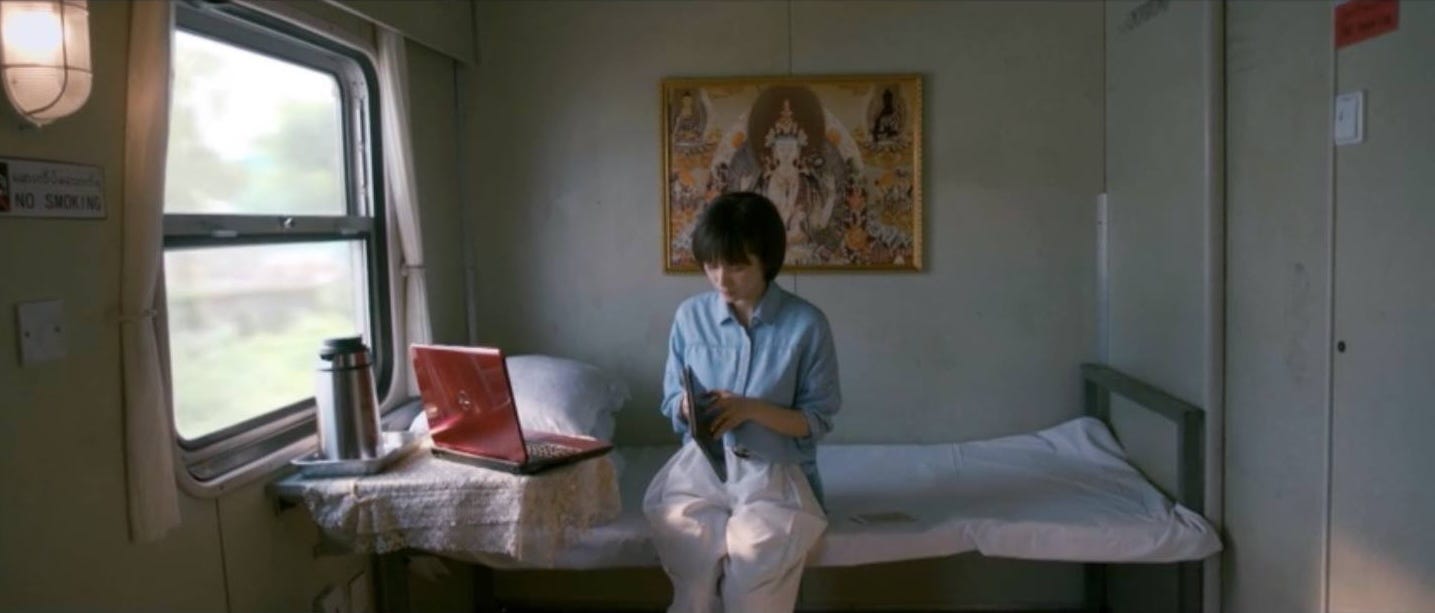
Once, my summers were marked by overnight train rides, going North from Tianjin to Northeast China, Changchun, over a distance of roughly 960 km.
There was a familiar progression to each of these rides, starting with buying large amounts of snacks, seeing my grandmother cry through the train windows on the platform, and silences before people got chatty and started to share fruit. In between overhearing my father’s conversations with strangers “going home, too” and watching service staff place large enamel flasks with hot water in dedicated nooks, my most cherished overnight train ride ritual were instant noodles.
Instant noodle cups were invented in the 70s after their initial launch as packaged pre-spiced noodles in 1958.1 Originally released onto Japanese markets by Taiwanese-born inventor and businessman Momofuku Ando, they soon became a huge success, with many local brands across Asia copying the concept. Ando had experimented for years with trying to make noodles last longer. The story goes that one night, he observed his wife frying vegetables and prawns in a pan, as his million-dollar idea hit him.
“Shock” or “flash-frying” became the key method to create the modern concept of instant noodles. During this process, all dampness is extracted from the noodles, and thus, their shelf life practically becomes immortal. The clue: this new technology was based on an old technique that had fed merchants and travellers on horseback as they took on a distance much greater than my childhood train rides.
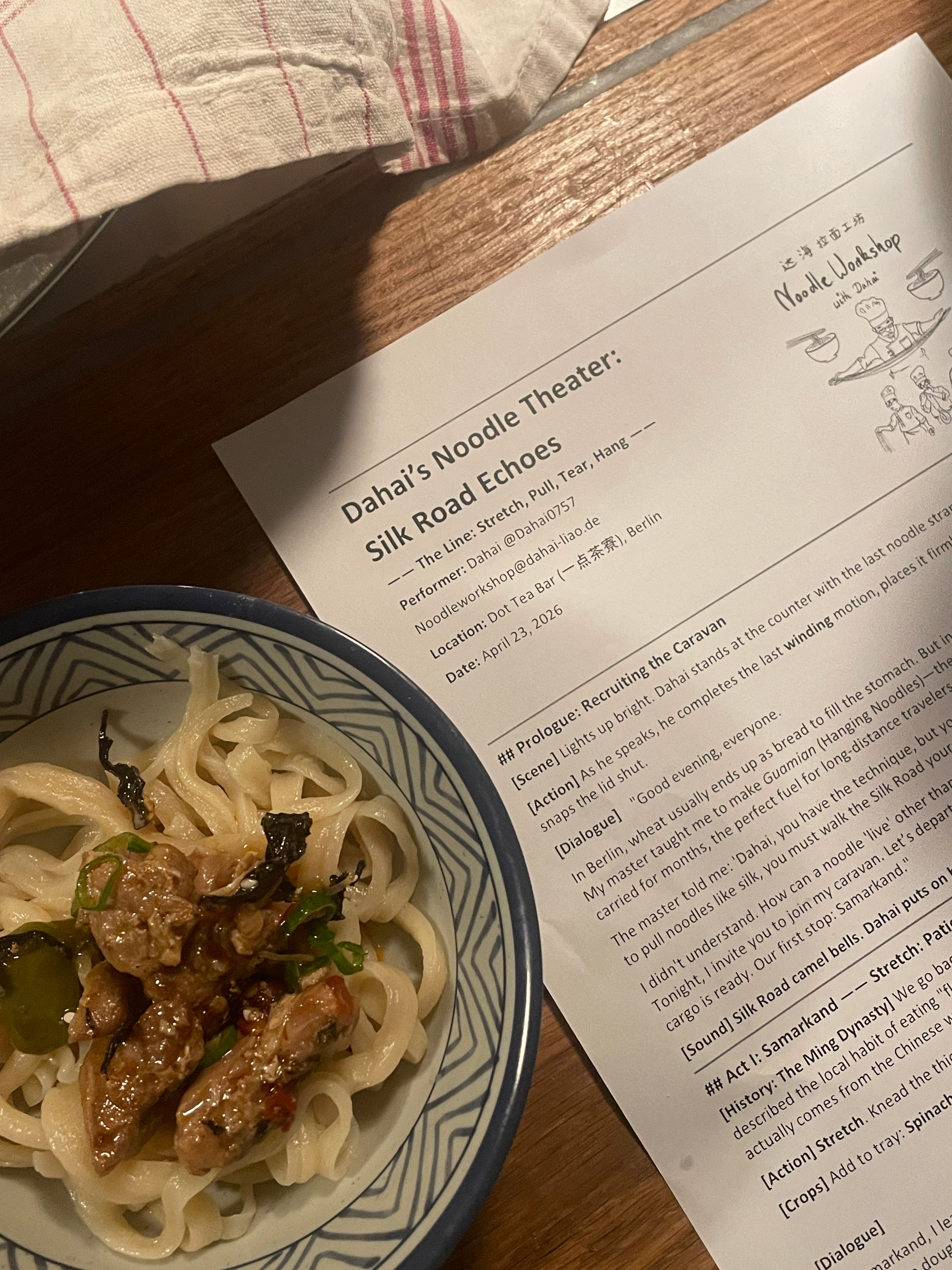
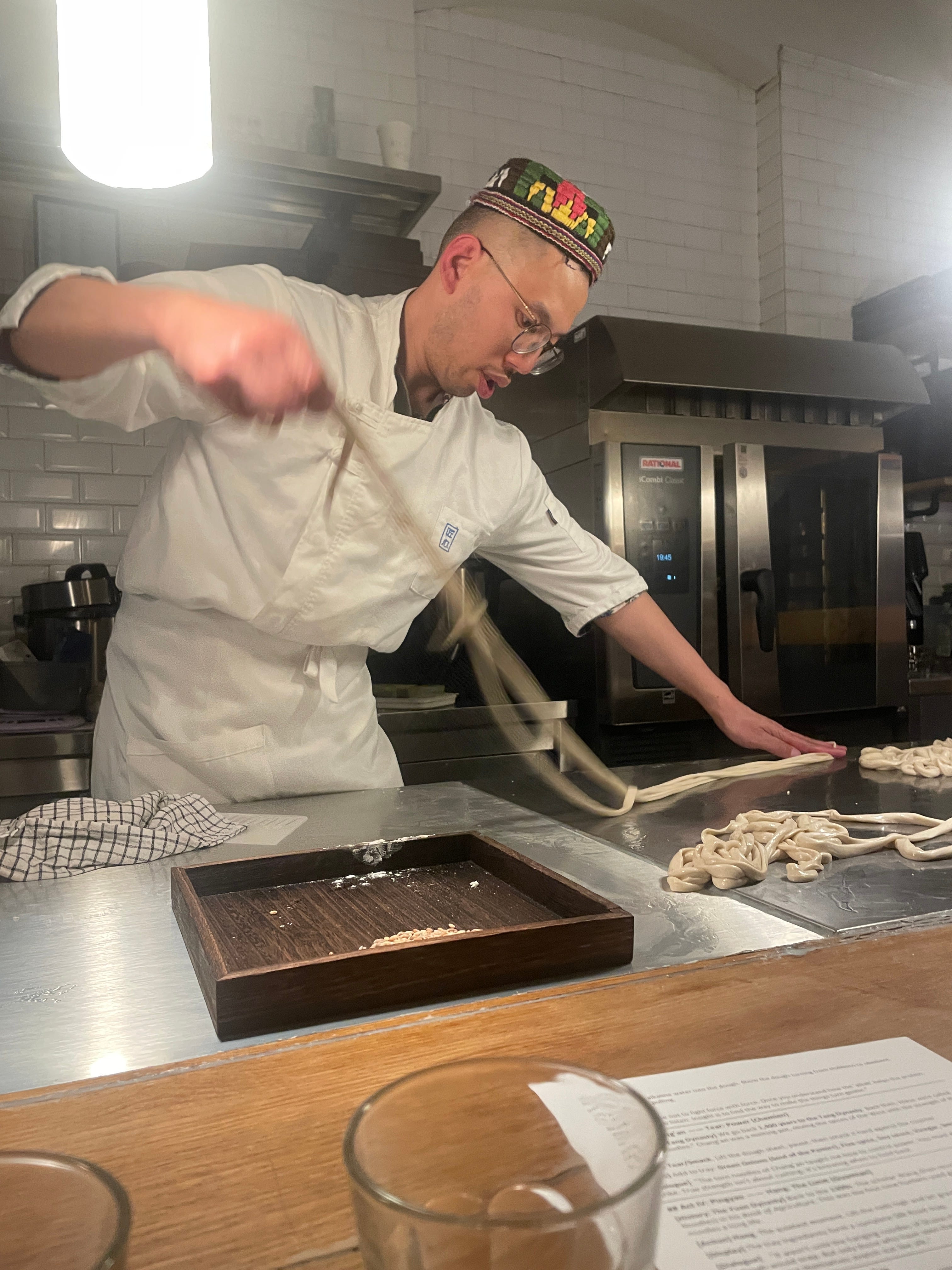
Tonight’s letter is a field study of a special kind of theatre, the “noodle kind” by noodle master Dahai. “Silk Road Echoes” is a culinary exploration of food history that unveils heritage through food, and myth through taste. This post is inspired by that rare event, beginning at a tea bar in Berlin, and taken further through time and space at the Moon Rabbit’s Silk Road Sarāy.
Happy Full Moon — and welcome back to this special guest house, in which we watch noodles pull us back and forth in time.
Preparing the Dough
Among the objects of the early Qijia culture in Northwestern China that were uncovered at Lajia are jades, oracle bones, traces of sheep herding. From these findings, we can piece together impressions of a people that lived here until circa 1000 BCE, when some natural disaster seems to have put an end to their existence.
Some twenty years ago, archaeologists also uncovered a bowl of noodles onsite, assessed to be 4,000 years of age.2 Food traces from a distant, distant age hold the power to demystify the past and pull it to the present. Suddenly, people of ancient times become actual bodies, consuming the same kind of food we enjoy today. Not exactly the same, of course. There are some striking differences.
As the patterning of the starch crops found in the bowl revealed, the noodles consisted of two kinds of millet.3 On their own, these kinds of millet would have been difficult to process, but their combination yielded a dough sticky enough to be pulled into noodles.
Wheat wasn’t always as popular as it is today, and it wasn’t until the Tang Dynasty that its popularity began to spread across the Empire along with its large-scale cultivation, ultimately replacing millet as the protagonist of Northern Chinese diets. Coincidentally, the Silk Road did play an important part in promoting and spreading wheat-based noodles.
Because wheat contains more protein than millet, its dough is smoother and softer, evoking a silky texture. The perfect ratio of water, flour, and salt, combined with a good resting time, can transform a sticky slob into a wonderfully flexible dough that stretches through entire villages.
Stretch it like silk
Wheat does not originates from somewhere between present-day Southeastern Turkey and Northern Syria in a corner of the Anatolian Plateau. Wild wheat thrived in this area from the end of the last Ice Age, attracting ancient peoples who eventually settled and domesticated this diploid wheat referred to as einkorn: diploid because this wheat only has two sets of chromosomes, and wheat DNA is a surprisingly complicated matter.4 Ever since, wheat has undergone its own kind of evolution by means of cross-breeding at the hands of farmers and the means of time. Today, diploid einkorn wheat has mostly transformed to “bread wheat” - a hexaploid wheat that dominates the world, and was introduced to China more than 4,000 years ago.
So how did wheat end up there, travelling all the way from the Anatolian Plateau through the “Fertile Crescent”, formed by present-day Palestine, Jordan, and Syria and the Tigris-Euphrates River Valley?
Geographically, the Eurasian steppe belt forms the most likely connection. Through the peoples that traversed its landscapes, wheat was transmitted first in its raw and unprocessed form, which people didn’t seem to love. Its harsh gruel was considered inferior to millet, associated with frugal life.5
Only with the advancement and distribution of stone mill technology, wheat could be processed to flour, which boosted its popularity by becoming more affordable, too. The rest is history. Today, China is the world’s number one wheat consumer6, with wheat defining the cultural identity of the North, splitting the country in two.
We often associate crop cultivation with farmers and sedentary life in agricultural societies. However, hand-pulled noodles made from wheat flour are not the result of any one culture staying in a place for hundreds of years brooding over what makes the perfect kind of dough. Riders carried sun and air-dried noodles on horseback like they had carried wheat before. Just as in Ando’s version, they only needed to add hot water.
It is probable that these same people who carried noodles on the Roads were directly involved in the genesis of Laghman, a signature hand-pulled noodle dish across many Central and West Asian countries to this day. A staple of Uyghur and Hui cuisine, the name itself hints at the cultural exchange that brought it into existence. Coming from the Chinese “lā miàn”, Laghman are an adaptation of Chinese pulled noodles that were again re-introduced back to China via the same Roads that birthed them.
At the heart of the Silk Road, the Hexi corridor, the famed “Lanzhou Beef Noodles” reached their final form in Gansu during the Qing Dynasty and are attributed to Ma Baozi, an elderly man of Hui Chinese descent.7
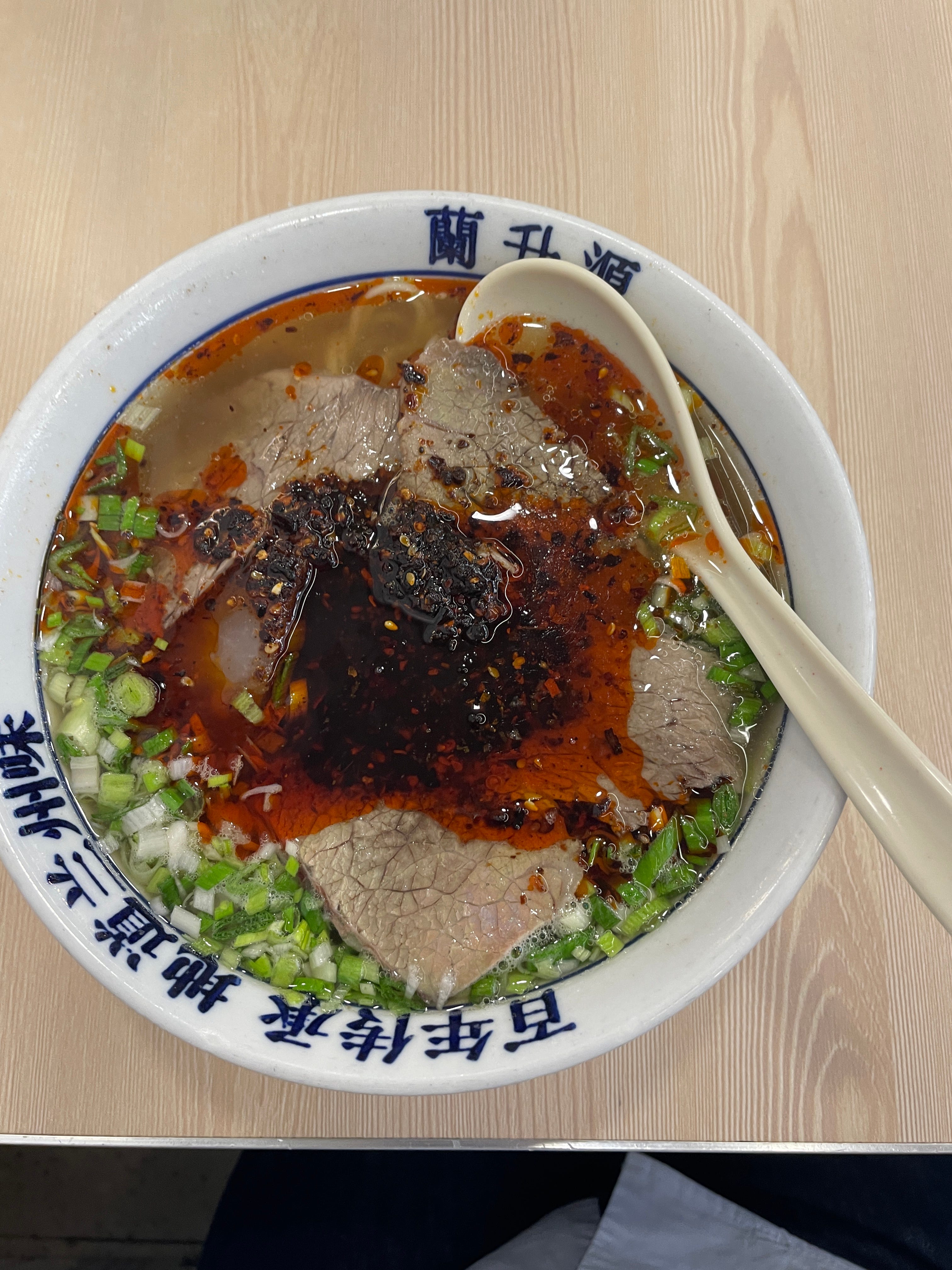
Served with scallions, chilli, and thin beef slices, the noodles are delicate and thin, submerged in a clear broth packed with hearty flavours that yet retain a surprising gentleness. How? At these junctures of the Silk Road, the Northwestern regions of China, the climate is characterised by extended rough winters and short, extreme summers. Spicy and fatty foods are the local response, pronounced by the presence of red and hot meats like beef and mutton and the absence of pork due to the predominately Muslim peoples.
The secret to this softness is hidden in the alchemy of a salt-loving (halophytic) plant found in these regions, too. Like a local mediator, this plant strengthens the network of ingredients, alleviating harshness. In English, this plant is translated as White-stemmed Halogeton, in Chinese, it’s sometimes called 蓬蓬草 - Pengpeng Cao. Burned and splashed with water at just the right temperature, this plant does not simply turn to ash, but transforms into a fused rock because of the high mineral / alkaline content melting together. With crucial amounts of potassium carbonate, Penghui is the reason why the noodles end up feeling springy and light, giving the dough that irresistible flexibility when rested and pulled.
Forming the myth
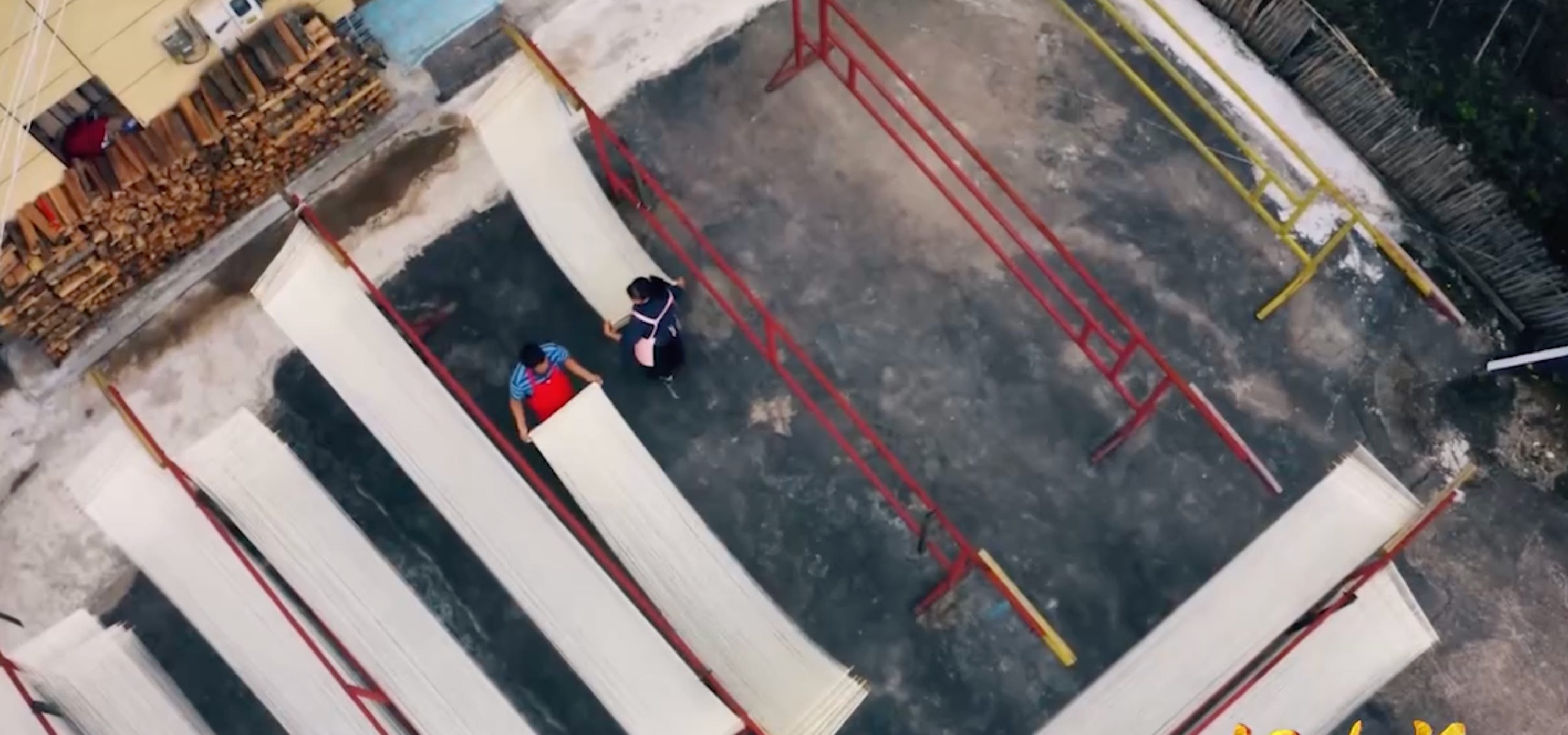
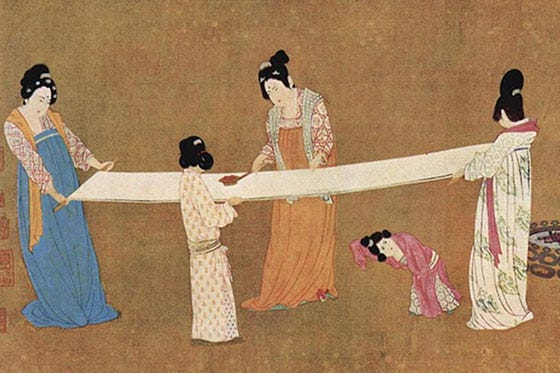
Pulling noodles has likely been compared to pulling silk since at least the Song Dynasty, as this craft, along with enhanced stone milling technology and a thriving food vendor culture, culminated in an era of creative culinary experimentation.
Like silk, wheat was now hailed as a “gift from the gods”, rebranded as the smell of hand-pulled noodles, soaked in spiced oils that came from the Silk Road, and topped with minced meat, rhapsodised all. Ultimately, wheat-based noodles reached even the South, where ultra-thin Misua evolved as a popular choice for Chang Shou Mian - Longevity Noodles that are pulled into a total length of 32 metres for drying.
In the local lore of Fujian, Longevity Noodles originate from the Lady of the Nine Heavens, Jiu Tiān Xuannü (九天玄女), who is revered as the goddess patron of these noodles.8 According to legend, Jiu Tiān Xuannü was musing on what to gift her mother, the famous famous Queen Mother of the West, for her birthday. To a Goddess Queen known for growing peaches of immortality in her garden, most material gifts will seem quite pointless. The Lady of the Nine Heavens thus prepared a batch of freshly cooked noodles and served them in a heavenly broth. That, apparently, did not disappoint. Even the Queen Mother of the West could taste her blessings, and the story ends with this present passed onto mortals outside of the divine realm.
As the Cultural Revolution swept China centuries later, turning the Republic into the People’s Republic, wheat-noodles became an unattainable dream for many, a fantasy as fleeting as oasis kingdoms in the desert, or riders carrying wheat across mountains and rivers. Unaware of how precious these kinds of noodles were to my parents, I still felt a wave of joy when I was presented with my own “Birthday Noodles”, my mother’s adaptation of longevity noodles, as a child. Although she cheated a bit and used spaghetti, they still had her own Hui-inspired twist, the faintest echo of a heritage I was yet to discover. Much to the dissatisfaction of my father, my longevity noodles were served with beef, not pork. To me, the taste was ravishing.
“They will stretch your entire life into happiness”, she said, “may you have a long and fulfilled life.”
From food to poetry
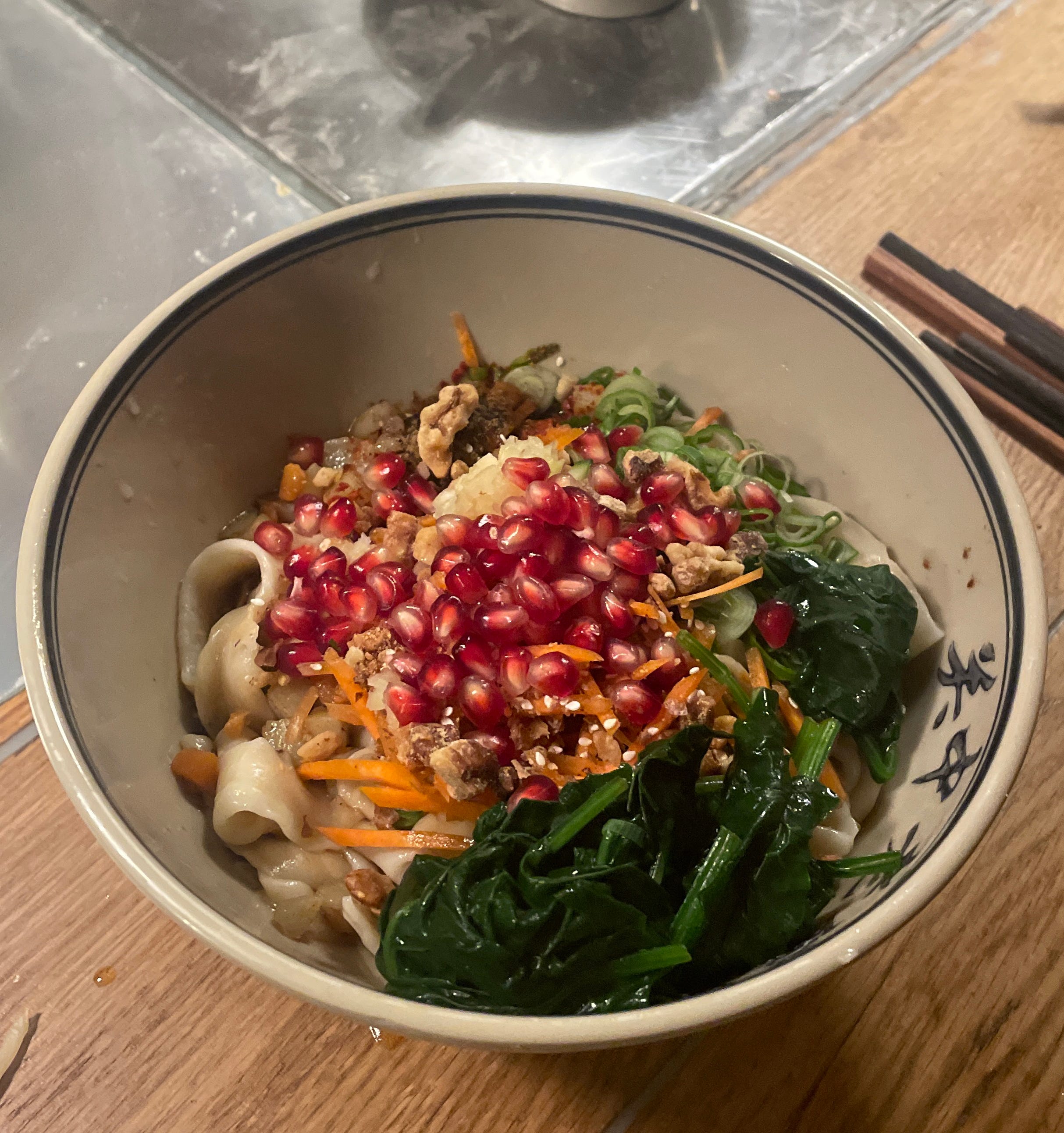
To end and to stay true to my tiny habit of writing tanka anywhere, here’s one about noodles:
The table is sticky tonight,
memories knead into dough,
ancestors unknown on roads.
Watching as he pulls apart
history, where does it start?
Thank you for joining the Silk Road Sarāy, and I want to give a special shout-out to Noodle Master Dahai. If you are in Berlin and interested in trying your hand at pulling noodles, or attending a workshop that blends food history and tasting, I recommend that you follow along and reach out to Dahai via his Social Media channels.
Next time at the Silk Road Sarāy, we’ll be exploring the first books from my reading list / personal curriculum Women Who Shaped Tongues:


Japan Experience (2024). Momofuku Ando Instant Ramen Museum: a Journey through the History and Creation of Instant Noodles. [online] Japan-experience.com. Available at: https://www.japan-experience.com/all-about-japan/osaka/museums-and-galleries/momofuku-ando-instant-ramen-museum-a-journey-through-the-history-and-creation-of-instant-noodles.
Roach, J. (2005). 4,000-Year-Old Noodles Found in China. [online] History. Available at: https://www.nationalgeographic.com/history/article/4-000-year-old-noodles-found-in-china.
Ibid.
An Chengbang. “The Encounter Connected Wheat and Noodles.” Key Laboratory of Western China’s Environmental Systems (Ministry of Education), College of Earth and Environmental Sciences, Lanzhou University, vol. 38, no. 4, pp. 253-256. Translated online for personal/academic use.
Ibid, p. 255.
Nov 2019, C.C. / 20 (2019). Why Did Chinese Farmers Switch to Wheat? [online] Sapiens. Available at: https://www.sapiens.org/archaeology/chinese-farmers/.
Wikipedia Contributors (2024). Lanzhou Beef Noodles. [online] Wikipedia. Available at: https://en.wikipedia.org/wiki/Lanzhou_beef_noodles.
Maja Noodles、覺色廣告設計 (2018). Origin of Noodles | Maja Noodles. [online] Majanoodles.com.tw. Available at: https://www.majanoodles.com.tw/en/about-1.php [Accessed 31 May 2026].
Fascinating, Lucia. I love your Mum's birthday wishes :"They will stretch your entire life into happiness." How gorgeous. Do you still eat noodles on your birthday?